
If there’s a reliable dietary culprit, “processed food” would be it. Whether the concern is excess fat, high sodium, too many transfats, sugar overdosing or cancer-causing chemicals, processed foods are high on the list of primary perpetrators. It’s not a stretch to think a majority of our diet-related issues could be solved or significalntly alleviated just by eliminating these foods. But first things first: Exactly what is a “processed food?”
Defining “Processed Foods”
The term “processed food” is actually fairly innocent. Truth be told, much of our food is processed, i.e., subjected to some kind of “process” to make it fit for human consumption. For those on the wholesome eating quest, the critical inquiry is not so much whether, but what and how much processing is done to a food. For this inquiry, I find the “Tree to Test Tube Continuum” to be a more helpful tool than an either/or definition.
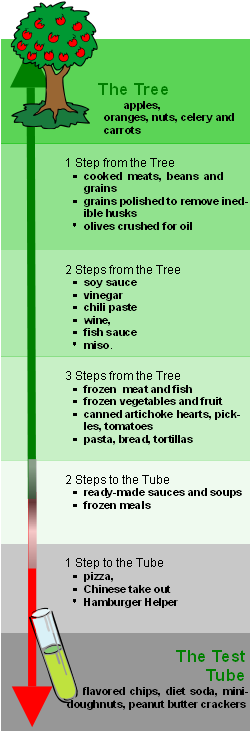 On the completely unprocessed, “Tree” end of the continuum are things like apples, oranges, nuts, celery, carrots and other things eaten “straight from the tree,” so to speak.
- A little farther from the tree are things that must be minimally processed so humans can eat them at all: meats, beans and grains must be cooked, inedible barley husks must be polished off, olives must be crushed for oil, etc.
- Since most of us like a little flavor in our foods, it’s not uncommon to step a little farther and add things like soy sauce, vinegar, chili paste, wine, fish sauce and miso.
- And sometimes we like things in the winter, when not available in our locale, so we take advantage of frozen and canned peppers, meat, fish, artichoke hearts, pickles, roasted peppers, corn and fruit.
- Sometimes we are short on time, so we take advantage of multi-ingredient sauces, soups and even entire dishes made by somebody else. Or we’d like something comforting like pasta, bread, tortillas, bagels and so on.
- Or we may be really pressed for time and so drop by a fast food joint, pick up a pizza, get some Chinese take out, opt for Hamburger Helper, etc.
- At times we get a slump in the afternoon and head for the vending machine for giant oatmeal cookie, a diet soda, some mini-doughnuts, or peanut butter crackers, at which point, we are solidly in Test Tube Land.
Must All Processed Foods Be Eliminated for a Healthful Diet?
While it would of course be ideal to eat within a step or two of the Tree, when experts talk about “eliminating processed foods” they are most concerned about those in the bottom gray zones, and it isn’t hard to see why. Processed foods in the top half of the continuum are processed minimally and simply, often just enough to make a food safely edible for the human digestive tract. There is very little, if any loss of nutrients and almost no chemical alteration. Foods in the lower half of the continuum, on the other hand, are more akin to manufactured products like crayons, tennis balls and sponges except that they are manufactured with food-grade materials, like:
- Grains that are stripped of their nutrient layers to create fluffy white filler material (then, ironically, artificially manufactured nutrients are added back)
- Fluffy filler material from grains that is extruded through machines to form things like pasta shapes, crinkly cereal flakes, curly chips, crackers, and so on
- Oils that are subjected to a laboratory process where extra hydrogen molecules are injected to increase shelf lives
- White sugar, added to almost everything, that is produced through a complex refining process that turns tough, fibrous canes into white crystals
- Handy test tube fillers and thickeners, like Methocel, “a slippery, gooey stuff” made by grinding wood into a pulp and then washing it with chemicals to break it down. Initially used as a thickener for tile putty and drywall mud, you can now find it in everything from frozen pot pies to salad dressings.
- Countless test-tube flavors to make food products taste appealing (and scientists are now creating ever more powerful flavors because our taste buds have become numb to what’s currently on the market.)
This much is clear: Our bodies were designed to run on real food, not factory-made substances, just like cars are designed to run on gasoline not turpentine. Feed our bodies the wrong fuel and break downs (along with increasingly expensive repairs) are a certain result. Hence the sound and obvious advice to steer clear of the Test Tube end of the continuum.
Things get trickier, however, when it comes to foods in the middle of the continuum, where green merges into gray. Is it OK to eat anywhere in this zone? That’s the subject of tomorrow’s post, “When Is It OK to Break the Rules?“

0 Comments
Trackbacks/Pingbacks