
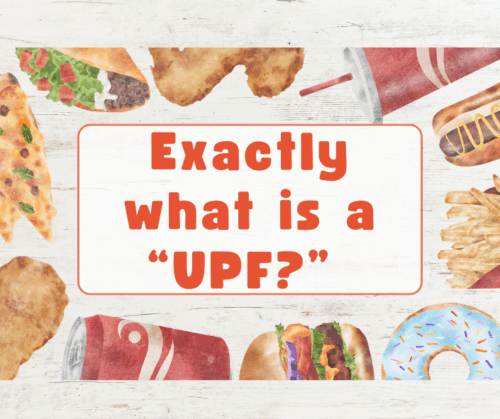
The Good News: We’re eating fewer ultra-processed foods! “The mean percentage of calories consumed from UPFs fell 3 percentage points since 2018.”
The Bad News: 53% of our calories are still coming from ultra-processed foods.
A Heartening Trend At least the trend shows that we CAN change! We can see through the marketing gimmicks and break free of the highly addictive nature of UPFs! Yay for us! (1)
Confusion? But are you still confused about exactly what is a UPF? In a nutshell, according to a recent Washington Post article (2), “ultra-processed foods are formulations of industrial ingredients that are designed by manufacturers to achieve a certain “bliss point,” which causes us to crave and overeat them.”
8 Red Flags The article then continued with a helpful listing of 8 red flags to identify UPFs. As I’ve harassed us multiple times, we must, must, must get in the habit of reading the ingredient listings for any packaged foods we buy. Here are quick summaries of the 8 red flags to watch for, but read the entire article to understand them more fully.
Watch out for products that:
- Have more than 3 ingredients. Certainly, some healthful packaged foods can have more than three ingredients. But beware of long lists that “sound like a high school chemistry experiment,” with preservatives, emulsifiers and shelf-life extenders such as sorbic acid, calcium propionate, datem, and monoglycerides.
- Contain thickeners, stabilizers or emulsifiers, dyes and preservatives, like soy lecithin, guar gum, xanthan gum, carrageenan, mono- and diglycerides, or carboxymethylcellulose.
- Include added sugars and sweeteners, like corn syrup, can sugar, malt syrup or molasses.
- Contain ingredients that end in “-ose,” like sucrose, dextrose, maltose, fructose or glucose (which are other names for sugars.)
- Contain artificial or fake sugars, like aspartame, sucralose, acesulfame-k, or saccharin.
- Have packaging with buzzy marketing claims that advertise questionable health benefits, e.g., “low-sugar” claims that can be code for artificial sweeteners.
- Claim to be “instant” (which usually means it is mechanically altered in a way that degrades it ) or claims to be “flavored” (which usually means it contains artificial flavorings.)
- Are something you couldn’t make in your own kitchen–probably the easiest to follow guideline!
(1) “Ultraprocessed Foods Provide Most of Americans’ Calories,” WSJ August 8, 2025, p.A5
(2) “Look for These Red Flags to Identify Food That Is Ultra-Processed,” The Washington Post, January 2, 2024. https://wapo.st/48dtP9U


0 Comments