
This post is part of a continuing series on Food Marketing Shenanigans that explores: How does it happen that when it comes to food, smart people are often not so very smart? It’s because we need a different kind of smarts to stay healthy in an unhealthy food environment, i.e., “marketing-smarts.” (Find Part 1 in the previous post.)
Test Your Marketing Smarts
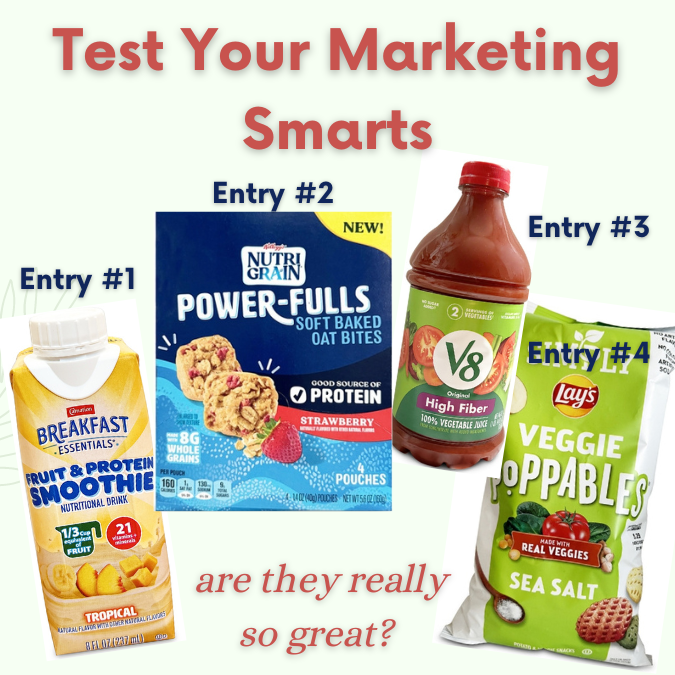
Take a look at these temptingly yummy and convenient products. Can you see how we’re being played by their expertly crafted health claims and jazzy packaging?
Entry #1: Carnation Fruit and Protein Smoothie
This breakfast “essential” is hitching a ride on the smoothie trend. Smoothies are healthy–and protein, too, right? Except that this one has “more glucose syrup (added sugar) than fruit purée,” and honestly, 1/3 cup of fruit is not exactly a big deal. Meanwhile, the “protein” is from just a couple refined and isolated protein sources.
Entry #2: Kellogg’s Power-Fulls, Strawberry Oat Bites
Here’s another protein play, but you could easily get more than Power-Full’s 6 grams of protein by snacking on a string cheese, a hard-boiled egg, peanuts or pistachios, or Greek yogurt–and you could avoid the four different kinds of added sugar, as well as all the additives. And about the strawberries advertised on the package, they are really “only strawberry flavored apples colored with vegetable juice!”
BTW, Kellogg’s recently spun off its traditional cereal business to better concentrate on its snack business. The reason? Snack foods have become one of the most profitable food categories.
Entry #3: High Fiber V8 Juice
V8 is trading on its reputation as a healthy blend of vegetable juices by touting this new “high-fiber version.” But the extra fiber only comes from the addition of soluble corn fiber—a processed fiber frequently used to make us think we’re eating a fiber-rich food. Real fiber is easy to get from real, whole foods like beans, bran, whole grains, nuts, seeds, fruits, and vegetables.
Entry #4: Lay’s Veggie Poppables
“Made with Real Vegetables?” Touting “made with” when it means “made with very little” may be the oldest trick in the food marketer’s book. Veggie Poppables have more potato starch and oil than pea flours or tomato or spinach powders. And then the mixture is fried in poor oils–hardly a substituted for real spinach, tomatoes and beets.
Do you notice how all these packaged foods are appropriating the healthy attributes of real, whole foods to sell us sorry facsimiles?
Whether it’s more fiber, whole grains, vegetables or protein, the message is that we’re taking good care of ourselves by eating these ultra-processed foods–because make no mistake, these are all highly processed foods that are health-damaging and the root cause of our ill-health. (See my webinar on Breaking Free of the Processed Food Force Field)
These examples came from a Nutrition Action post by the Center for Science in the Public Interest. Be sure to read the full article and consider signing up for its newsletter which always has some enlightening insights into our food supply.

![[VIDEO] Vitamin Frenzy](https://thenewkitchen.org/wp-content/uploads/2026/05/Screenshot-2026-06-25-at-11.14.13-AM-400x250.png)
0 Comments
Trackbacks/Pingbacks