
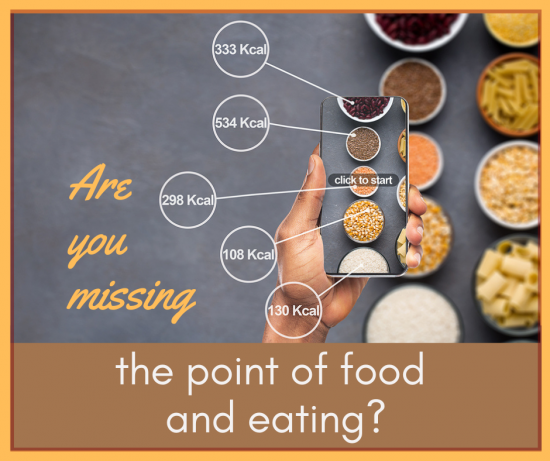
Calories.
Are they lurking in your brain? Not actual calories, of course, but worries about calories?
In other words, whenever you eat something, does calorie anxiety get rousted from the recesses of your brain and start making you uncomfortable:
- Wow, I bet there are a lot of calories in this _______________.
- I wonder how many calories are in this ___________.
- Is this ______________ going to put me over my calorie budget for the day
- I probably shouldn’t be eating this ___________ because it has so many calories.
Brown Rice I remember talking with a friend some time ago when the subject of whole grains came up, particularly brown rice. She asked if I ate it and I said, “Yes, I sure do!” At that, her eyes widened, “Ohhhh, but it has so many calories!”
At the time, I was confounded by her reply and didn’t know how to respond. How do you say that brown rice has “so many calories” with no point of reference?
But now I get it: She was just reacting from the “calorie fixation” common in today’s food world.
Calories IN/Calories OUT Since forever, we’ve been trained to be calorie-conscious by the diet and health industry: Make sure calories IN are less than calories OUT!
Calories = Bad Necessarily, calories came to be equated with bad–something we shouldn’t be eating or at least should try to avoid as much as possible
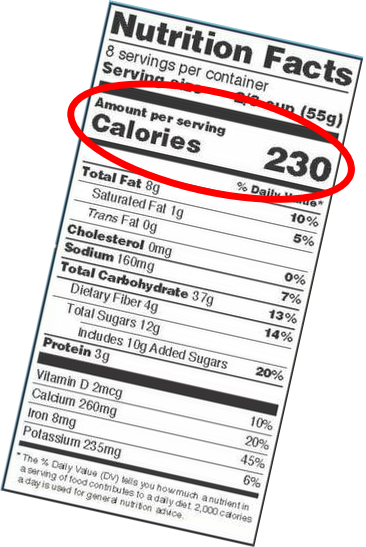 Nutrition Facts Labels And then along came the Nutrition Facts labels with “Calories” right up top, big and bold, so we can easily and always track them.
Given all this, we not surprisingly developed a singular focus on calories. All day long, our brains are almost subconsciously tallying up calorie counts and feeling guilty about eating too many.
But has the calorie thing gone too far?
The Point of Food Of course food contains calories–that’s “the point of food!” Since food is something we eat to fuel our body, of course it must contain calories.
What’s more, calories are neither good or bad. The term simply refers to units of energy.
Hooray for Calories Really, instead of being fearful and anxious about calories, we should thank goodness for the calorie energy that food provides! Without adequate amounts of that energy, our brains couldn’t think, our organs wouldn’t function and our bodies wouldn’t be able to move. In fact, we wouldn’t be alive without the energy in food.
The Critical Inquiry But we don’t just want to be alive. We want to thrive and be well, have good energy, and be able to enjoy life. That’s where the more critical inquiry comes in:
What are you getting for the calories in a food?
In other words, are you getting things like protein, fiber, phytochemicals, flavanoids, omega 3s and all the hundreds of other vital nutrients that your body needs to not just stay alive but to thrive?
For the calories in brown rice, as an example, you’re getting a food “loaded with vitamins and minerals,” including plant lignans, magnesium and selenium for heart health; manganese with a whole variety of health benefits; bran and fiber for cholesterol control, digestion and gut health.(1)
Meanwhile for the calories in chocolate cake (which we’ll readily eat with a due helping of respectful guilt !), we get practically nothing since it’s made mostly of nutritionally void sugar and white flour.
Calorie Container vs. Nutrient Package Really, it makes no sense to talk about this food or that having “not very many” or “too many” calories. Because food is not just the calories it contains. While that is one aspect, equally important is the nutrition you get for the energy units in the food.
Suggestion While it’s important to understand food’s full nutritional nature, I would actually suggest that on an everyday basis we stop thinking of food in either of calories or nutrients. Food is so much more than the components assigned to it by the nutrition industry.
Instead, how about channeling our mental food energy into food preparation. In particular, make inviting and delicious meals that contain only real, whole foods like fruits, vegetables, clean proteins, good fats, nuts, legumes and whole grains. Then take the time to sit down, relish those meals—and don’t worry about calories!
Just experiment making meals that contain only a richly diverse and balanced array of real, whole foods. See if your body doesn’t regulate your calorie needs all by itself. Then, all you need “worry” about is loving the real and wholesome taste of good food and feeling the comfort, deep satisfaction and nurture it provides.
This natural and far more relaxed approach has served me well for years. I’d love to hear how it works for you—but be aware that it doesn’t happen overnight. It may take some weeks to take root and then grow over the succeeding months to become a firm foundation.
(1) https://draxe.com/nutrition/brown-rice-nutrition/


![[VIDEO] Vitamin Frenzy](https://thenewkitchen.org/wp-content/uploads/2026/05/Screenshot-2026-06-25-at-11.14.13-AM-400x250.png)
0 Comments