
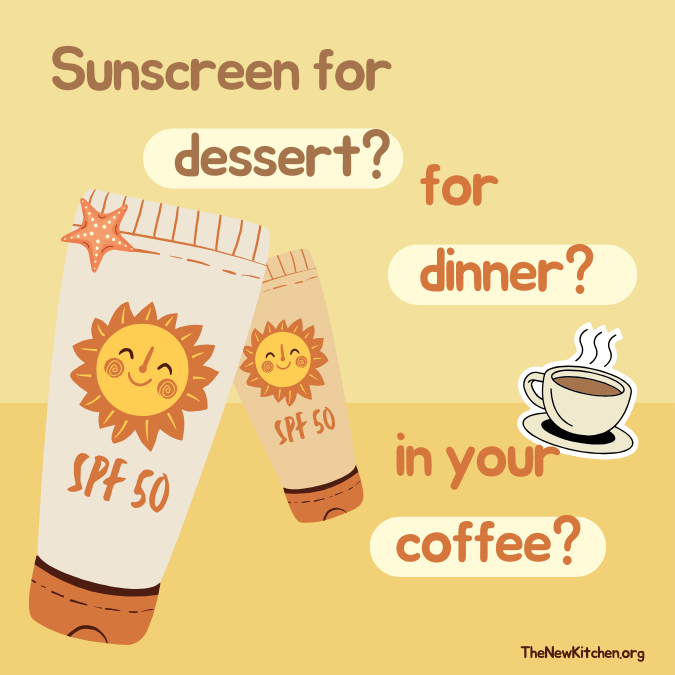
You might remember this post: “Do You Put Antifreeze on Your Skin? In Your Mouth?”
That article explained how propylene glycol, an ingredient in anti-freeze, is also used in both cosmetics and food. Since posting that article, I’ve run into a couple readers who mentioned that they were now taking a closer look at ingredient listings. Both were shocked.
Jane, for example, was about to put a first-aid spray on an open cut when she noticed that it contained propylene glycol. So it could have gone right into her bloodstream. Then her dentist recommended a fluoride rinse product called Act.
“I was already suspicious of the fluorescent green color [good instinct!], and when I read further into the ingredient list, there was the propylene glycol! So, you can spray it in your wounds and flush it around your mouth. NO THANKS!!”
Interestingly, shortly after the anti-freeze article, news of yet another additive came along: “The Substance Lurking in Food, Titanium dioxide, an ingredient in sunscreen, is also in pizza, candy and other popular items.”
Wait a minute, what?!! Titanium dioxide is the bright white ingredient in sunscreen that helps block the sun’s rays.
And now why?!! Why would food manufacturers put a sunscreen ingredient in our food?!!” Well, we consumers are kind of the problem. We like nice white and bright foods, like really white cheese on pizza, creamy white frosting on cakes and green salsa that pops with color.
Putting two and two together, food manufacturers figured they could simply add a little titanium dioxide to a food and everything from salsa verde to sauces and creamers would look brighter and more appealing. Then, lucky for manufacturers, we would buy more.
Is this hard to believe? When you see a product in the grocery store, do you assume it must be safe? I did for a long time, until I started reading ingredient listings. So what can we do?
1. Food Photo Funniness Don’t get tricked by the photos in food ads. Foods are carefully staged to look uber-appetizing, using lighting, backgrounds–and additives like titanium dioxide.
Real, whole foods are plenty bright and colorful. Naturally, however, manufacturing dulls them a bit, hence the need to whiten and brighten them artificially–and often in ways that aren’t healthy.
BTW, this also applies to food photos for recipes. They are often taken before the ingredients are fully cooked. So don’t be surprised or disappointed if your dishes don’t look as bright and colorful as the photos in the recipe. But that doesn’t mean you need titanium-generated whitening and coloring. Just adjust your “eyesight” and focus on the amazing flavors of nicely cooked real, whole foods.
2. Buyer Beware Protect yourself by reading ingredient listings as explained in this post. Know however, that titanium dioxide doesn’t always show up in the ingredient listing. Instead, manufacturers sneak it in under “artificial color.” That’s no problem, though, since we don’t want to be eating foods with artificial colors anyway!
3. Is It Worth It? Just before sending out this newsletter, along comes another sunscreen article from CSPI: “Is titanium dioxide hiding in your pantry, fridge, and freezer?”
It explained how tiny “nonoparticles” of titanium dioxide can potentially accumulate in the human body over time and cause genetic damage. In turn, damage to DNA is one way that chemicals can cause cancer and other health problems, while also damaging the immune and nervous systems.
Bear in mind that titanium dioxide is currently used in somewhere between 7,000 and 15,000 brand-name food products, so it would not be hard to get a dangerous accumulation in your body–which is probably why the European Union banned the use of titanium dioxide in foods in 2022.
The tragedy is that we’re being tricked into risking our health–maybe our lives–for what? Just so a food can look whiter and brighter? Is it worth it?
Taken from: “The Substance Lurking in Food,” WSJ June 13, 2024; “Titanium Dioxide Is Lurking in These Halloween Candies,” Center for Science in the Public Interest, October 9, 2024.

![[VIDEO] Vitamin Frenzy](https://thenewkitchen.org/wp-content/uploads/2026/05/Screenshot-2026-06-25-at-11.14.13-AM-400x250.png)
0 Comments
Trackbacks/Pingbacks