
Lunch was a little disappointing the other day.
- I had fresh green beans from my garden, but overcooked them. And forgot to season them.
- Had some lovely sable fish from my fish share, but cooked it too fast, turning it into a jumble of bits and pieces.
- Heated up some kabocha squash that I baked the other night, but it was still firm on the inside and only lukewarm.
Sure it was a perfectly healthy meal, but pretty darn dull. In other words, it was far from perfect, which left me wary and less than motivated about making my next meal.
Hence this caution: Watch out for the kitchen curse of perfection expectations.
Interestingly, just before lunch I had read a book review for The Perfection Trap: Embracing the Power of Good Enough. While perfectionism “seems to be the defining characteristic of our time,” the book explains, “perfectionism has not always been held in such high regard.” *
The book’s author, Thomas Curran, posits some fascinating, macro-economic theories to explain why perfectionism has risen to such prominence today. While I agree with his theories, I have long wondered if there isn’t a simpler reason the perfection trap ensnares us in the kitchen, i.e., because our food world continually confronts us with perfectly prepared and plated meals—in restaurants, cookbooks, internet recipes, magazines, cooking shows and even ordinary blog posts. Moreover, when we eat out, almost every meal is perfectly tasty (even if far from healthy!)
Without a doubt, I love visually appealing, flavor-packed meals and do my best to make meals that make my taste buds happy and satisfied. Success definitely makes me happy, too.
But perfect success doesn’t happen all the time. When I feel the thud of disappointment, like after lunch today, I have to exercise some vigilance to make sure it doesn’t zap my meal making motivation.
I’m guessing at least of few of you might have had some run ins with the perfection trap. Maybe it has even derailed your healthy meal making efforts for a little or a long while? That’s why I want to make you aware of this mischievous gremlin.
Having compassion is a popular topic these days. Meal making is probably a good place to practice a little compassion and be more accepting of less-than-perfect results. After all, one less-than-stellar meal doesn’t mean you’re doomed to a lifetime of dreary meals!
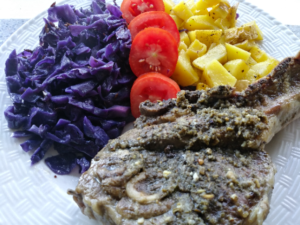
As for me, I climbed back in the saddle at dinnertime and made lamb chops with Savory Spice’s Limnos Rub, potatoes from my garden, and sauteed cabbage with caraway seeds. Nothing fancy, but it looked good, tasted great and reignited my meal making motivation!
* “The Enemy of the Good,” Bill Heavey’s review of The Perfection Trap by Thomas Curran, The Wall Street Journal, August 10, 2023 p. A13.

![[VIDEO] Vitamin Frenzy](https://thenewkitchen.org/wp-content/uploads/2026/05/Screenshot-2026-06-25-at-11.14.13-AM-400x250.png)
![[VIDEO] Vitamin Frenzy](https://thenewkitchen.org/wp-content/uploads/2026/05/Vitamin-Frenzy-e1780010820776-400x250.png)
0 Comments